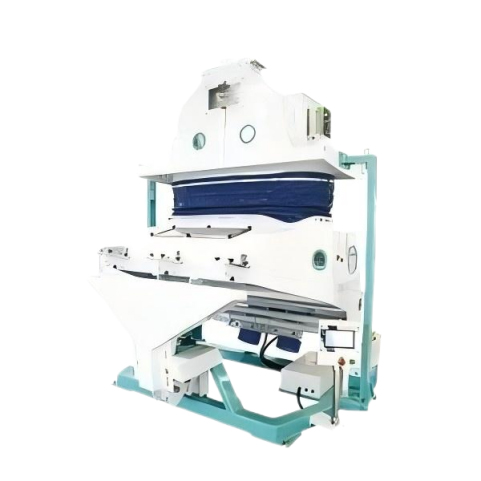
Unique selection chamber to separate stones from grain,especially errective for brown rice.
Unique sieve structure to save blowing rate.
Negative-pressure air suctionto prevent dust from escaping the machine.
| Availability: | |
|---|---|
| Quantity: | |
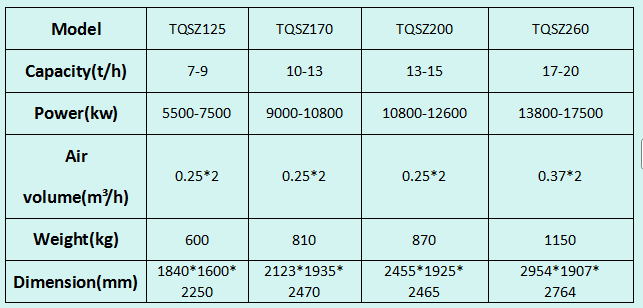
The Suction Type Gravity Destoner Food Processing Equipment represents a critical cleaning solution in grain processing, designed to remove heavy impurities such as stones, clods, and metallic particles from various grains. Operating on the principle of differential specific gravity and air classification, this equipment achieves an impressive 99.9% stone removal efficiency, ensuring grain purity and protecting downstream processing equipment from damage. With processing capacities ranging from 1.2 to 12 tons per hour across different models (TQSX85B to TQSX168), it accommodates diverse production scales from small mills to large food processing facilities.
The destoner's innovative design combines mechanical vibration with controlled airflow to separate impurities, making it suitable for processing paddy, wheat, corn, soybeans, and various oilseeds. Its compact footprint and modular construction allow easy integration into existing processing lines, enhancing overall cleaning efficiency without requiring extensive facility modifications.
The equipment features an adjustable inclined sieve deck (10-14 degrees) that creates differential movement between grains and heavy impurities. Combined with upward airflow (1.2-1.3 m/s), this system effectively stratifies materials, with grains floating on the air cushion while stones and heavy particles descend to the separation outlet.
An external centrifugal fan provides consistent airflow with adjustable volume (3200-7800 m³/h depending on model), ensuring optimal separation across different grain types and moisture levels. The sealed air circulation system minimizes energy loss and prevents dust emission into the workplace.
Rubber damping bearings and precision-balanced vibration mechanisms reduce operational noise to below 80 decibels. This not only improves working conditions but also allows installation in noise-sensitive areas without additional soundproofing.
Quick-release sieve panels allow for easy cleaning and replacement, with minimal tools required. The self-aligning bearings with anti-loosening devices reduce maintenance frequency, extending service intervals to 3000 operating hours under normal conditions.
Installed at the initial stage of grain processing lines, the destoner removes physical impurities from raw grains, protecting subsequent equipment such as hullers, mills, and polishers from abrasive damage and reducing maintenance costs.
In seed processing facilities, the equipment ensures high-purity seed stocks by removing inert matter that could compromise germination or seed quality. The gentle handling preserves seed viability while achieving thorough cleaning.
For food-grade grain processing, the destoner plays a critical role in meeting food safety standards by eliminating potential contaminants that could cause product recalls or health hazards. It effectively removes stones that could break teeth or damage processing equipment.
Optimal performance occurs with grain moisture between 12-15%. Higher moisture levels increase grain density, reducing stratification efficiency, while excessively dry grains may be carried out with impurities due to lower density. The airflow and vibration settings can be adjusted to compensate for moisture variations within ±2%.
Daily tasks include cleaning the sieve surface and checking air filters. The sieve tension should be inspected weekly, and worn sieves replaced when openings show significant wear (typically after 6-8 months of continuous operation). The fan impeller should be inspected quarterly for dust buildup that could affect airflow.
Yes, the equipment is adjustable for various grain sizes by changing sieve meshes and adjusting airflow. Specialized sieve configurations are available for small grains like millet (0.8mm mesh) up to large grains like soybeans (5mm mesh), ensuring effective separation across the entire range of common cereals and oilseeds.
This high efficientrotary vibrating cleaning machine has gathered differentfunctions in one, can efficiently remove different sizes'impurities.
Use screw rollerfeeding device, The full width of the screen surface is uniform, with step-less output capacity adjustment, digital display, simple and intuitive.
Airtight de-dust device, with less dust.
Use cardan flexible suspension system,which makes the machine work smoothly.
The cardan is durable, machine performs verystable.
Onelayer with brush cleaning structure, can automatically clean outimpurities.
Output capacity of single machineis big.
The ROTARY CLEANING MACHINE is a high-performance cleaning equipment under the Rice Mill Machine category, designed by Golden-Cereal™ to efficiently remove impurities from grains during processing. As a core component in grain processing lines, it plays a critical role in enhancing grain purity, ensuring downstream processing (such as husking, whitening, or grading) operates smoothly.
Unique selection chamber to separate stones from grain,especially errective for brown rice.
Unique sieve structure to save blowing rate.
Negative-pressure air suctionto prevent dust from escaping the machine.
Equipped with three main models—TQSX85B, TQSX100B, and TQSX125A—the machine caters to diverse production scales, with capacity ranging from 3.5-4.5 t/h to 7-8.5 t/h. Its advanced design ensures exceptional performance in removing impurities, especially for sensitive grains like brown rice, where preserving grain integrity is critical. Whether integrated into small rice mills or large-scale grain processing plants, this destoner enhances product quality by reducing impurity levels to below 0.1%, meeting international food safety standards.
Ideal for modern agricultural processing facilities, it integrates pneumatic technology with robust engineering to deliver consistent performance across varying operational scales. Whether deployed in small rural mills or large industrial complexes, this husker ensures high husking rate (up to 98%) and low grain damage (below 2%), making it a cornerstone for businesses prioritizing quality and productivity. Its adaptability to diverse paddy varieties and climates further solidifies its position as a versatile solution in global grain processing markets.
Learn how to specify the right grain conveyor belt to prevent dust explosions, oil damage, and downtime. Engineering-first guide for safety and ROI.
Learn how grain conveyors work and compare belt, drag, pneumatic & tubular systems to minimize kernel damage, boost throughput, and ensure safety.
Evaluate grain processing equipment with our guide. Cut breakage, maximize yield, and avoid costly downtime with proven procurement criteria.
Maximize rice milling yield and reduce broken grains. Expert guide to evaluating rice mill equipment for premium quality and ROI.
Maximize yield and cut energy waste. Compare dry, wet, and hydrothermal grain processing methods to choose the best equipment for your facility.
Learn how paddy huskers and separators work together to boost rice milling efficiency, reduce breakage, and maximize whole-kernel yield.
Pre-cleaning protects rice mills from costly damage. Discover how destoners and cleaners ensure pure grain, maximize yield, and meet safety standards.
Facing margin compression and labor shortages? A modern automatic rice mill plant reduces breakage, stabilizes energy costs, and scales your output.
Select the right rice mill dust collector to prevent abrasive wear, explosions, and health hazards while maximizing uptime.
Guide to selecting the best commercial Rice Mill Machine and optimizing the 5-step milling process for maximum yield and efficiency.
Optimize commercial paddy processing. Learn how to select grain dryers and rice mill machines to maximize Head Rice Yield and boost ROI.
Build a profitable commercial rice milling plant. Learn about essential machinery, steel structures, CapEx modeling, and vendor selection.
Calculate rice mill setup costs and optimize ROI with this guide on CAPEX/OPEX, machinery selection, and steel structure facility design.
Compare steel structures vs. concrete for agricultural plants. Discover key insights on construction speed, clear-span space, hygiene, and ROI.
The journey from harvested paddy to polished white rice is far more than a simple transformation; it's a high-stakes commercial operation centered on yield optimization and market grade. For modern millers, success isn't just about processing grain—it's about maximizing the recovery of whole, unbrok
The modern rice milling industry has transformed dramatically, moving away from labor-intensive manual processes to highly automated, efficient systems. While hullers, polishers, and sorters often take the spotlight, the true drivers of profitability are the "silent" heroes of the mill: material han
In the competitive global market, a fine line separates simply "milled" rice from "premium" rice. This precision gap is not just about basic processing; it's about achieving a final product with superior aesthetics, texture, and shelf life. The final gatekeepers in this transformation are the whiten
In the fiercely competitive global market, the definition of quality rice has evolved dramatically. It's no longer sufficient for rice to be merely clean; consumers and international buyers demand absolute uniformity, pristine appearance, and guaranteed safety. This shift places immense pressure on
The journey from raw paddy to premium, market-ready rice is a marvel of mechanical precision. The critical link in this value chain is the milling equipment you choose. Your selection directly dictates profit margins, product quality, and operational efficiency. Many new plant owners fall into the t